Direct answer first:
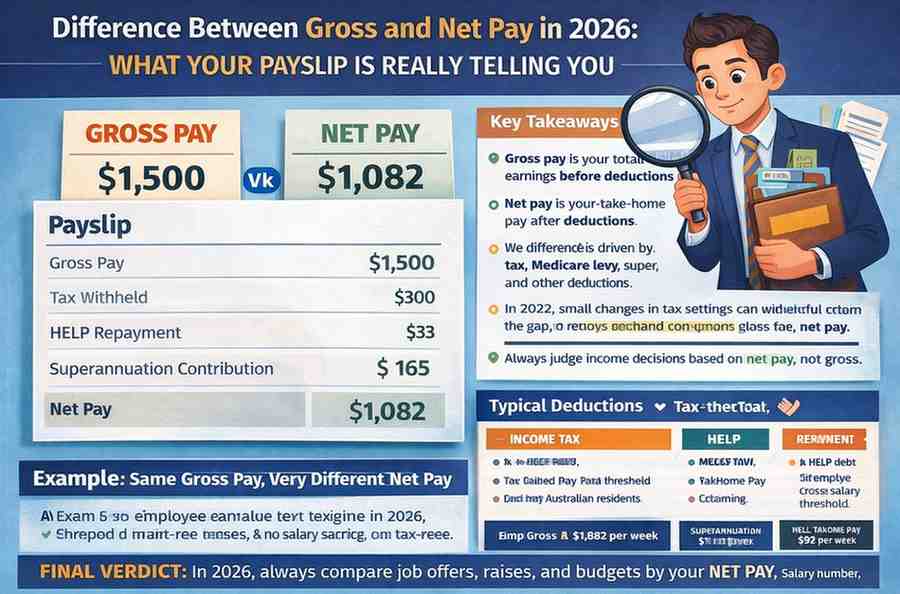
Gross pay is what you earn before anything is taken out.
Net pay is what actually lands in your bank account after tax, super adjustments, and other deductions.
In 2026, that gap between gross and net pay matters more than most people realise. I have seen smart, well-paid professionals misjudge job offers, overtime, and even promotions because they focused on gross pay and ignored what really counts – net pay.
After 15+ years working with payslips across industries, I can tell you this plainly: gross pay is a promise, net pay is reality.
Let’s break this down properly, without payroll jargon, and with the kind of detail most guides skip.
Key takeaways
- Gross pay is your total earnings before deductions
- Net pay is your take-home pay after deductions
- The difference is driven by tax, Medicare levy, super, and other deductions
- In 2026, small changes in tax settings can noticeably widen the gap
- Always judge income decisions based on net pay, not gross
What is gross pay?
Gross pay is the full amount your employer pays you before anything is taken out.
On a typical Australian payslip in 2026, gross pay includes:
- Base salary or hourly wages
- Overtime
- Bonuses and commissions
- Allowances
- Penalty rates
Think of gross pay as the headline number. It looks good. It sounds impressive. It is also incomplete.
I have sat in salary negotiations where someone proudly quoted their gross salary, only to later admit they were struggling with cash flow. The disconnect almost always comes down to ignoring what happens after gross pay.
What is net pay?
Net pay is what remains after all deductions. This is the amount deposited into your bank account.
Net pay is affected by:
- PAYG income tax
- Medicare levy
- HELP or student loan repayments
- Salary sacrifice arrangements
- Other agreed deductions
Net pay answers the only question that truly matters: How much money do I actually have to live on?
Why the difference matters more in 2026
In 2026, Australian payslips reflect a tighter relationship between earnings and deductions.
Here is why:
- Tax brackets continue to influence marginal deductions
- Medicare levy thresholds still apply
- Student loan repayments resume automatically once thresholds are crossed
- Superannuation rates remain visible but do not increase net pay
Many employees assume a pay rise automatically improves their financial position. In practice, some raises barely move net pay at all.
I have reviewed payslips where a $5,000 gross increase resulted in less than $50 extra per week after deductions. That shock usually comes too late.
Typical deductions that reduce gross pay to net pay
Income tax (PAYG withholding)
Your employer withholds tax each pay cycle under the PAYG system, following guidance from the Australian Taxation Office.
Tax withheld depends on:
- Your income level
- Whether you claimed the tax-free threshold
- Your employment type
This is usually the largest reason gross and net pay differ.
Medicare levy
Most Australian residents pay the Medicare levy. It applies even if you rarely use healthcare services.
This deduction is often overlooked because it is bundled into tax calculations rather than shown as a dramatic standalone figure.
Superannuation (important clarification)
Superannuation does not reduce your net pay in most standard arrangements. It is paid by your employer on top of your wages.
However, confusion arises when:
- Salaries are quoted as total packages
- Salary sacrifice to super is used
This misunderstanding alone causes thousands of disputes each year.
HELP or student loan repayments
Once your income crosses the repayment threshold, repayments begin automatically.
I have seen employees panic when net pay suddenly drops after a small raise. The payslip was correct. The HELP system had simply switched on.
Other deductions
These may include:
- Union fees
- Salary packaging
- Child support payments
- Voluntary deductions
Every deduction chips away at gross pay, sometimes quietly.
Example – same gross pay, very different net pay
Let’s say two employees earn the same gross pay in 2026.
Gross pay: $1,500 per week
Employee A:
- No HELP debt
- Claimed tax-free threshold
- No salary sacrifice
Employee B:
- HELP debt
- Did not claim tax-free threshold
- Salary sacrifices to super
Both earn the same gross pay. Their net pay differs by hundreds of dollars per month.
Same income. Different outcomes.
What others get wrong about gross vs net pay
“My salary is what my contract says”
Your contract shows gross pay. Your bank account reflects net pay.
“Super is taken out of my pay”
In most cases, no. It is paid on top, unless you agreed otherwise.
“Overtime always boosts take-home pay”
Not always. Higher marginal tax and repayments can soften the impact.
“A raise always improves cash flow”
Sometimes it barely moves the needle.
How to read your payslip the right way
This is how I advise people to read payslips in 2026:
- Start with net pay, not gross
- Review tax withheld trends over time
- Watch for sudden changes after raises or bonuses
- Confirm deductions match expectations
If your net pay drops unexpectedly, the payslip usually explains why. You just need to know where to look.
FAQ
Q1: Is gross pay the same as taxable income?
A: Not always. Some components may be treated differently for tax purposes.
Q2: Why does my net pay change when my gross pay stays the same?
A: Tax, HELP repayments, or Medicare thresholds may have shifted.
Q3: Does super reduce my take-home pay?
A: Only if you salary sacrifice or have a total package arrangement.
Q4: Should I negotiate salary based on gross or net pay?
A: Always understand the net impact before accepting an offer.
Q5: Can payroll make mistakes calculating net pay?
A: Yes, especially when details like thresholds or deductions are incorrect.
Final verdict
In 2026, understanding the difference between gross and net pay is not optional. It is essential.
Gross pay tells you what you earn on paper.
Net pay tells you how you live.
If you make financial decisions based on gross pay alone, you are flying blind. The smartest move you can make is to read your payslip like an insider and judge every job, raise, and bonus by what actually ends up in your account.
That is where the truth lives.
Generate Your Payslip in Seconds
Create an accurate payslip that clearly shows gross pay, tax deductions, superannuation, and net pay. Perfect for employees, freelancers, and employers who want clarity and compliance.
- Instant gross to net breakdown
- Tax and super calculated clearly
- Australia compliant payslip format
No signup required. Fast. Simple. Accurate.