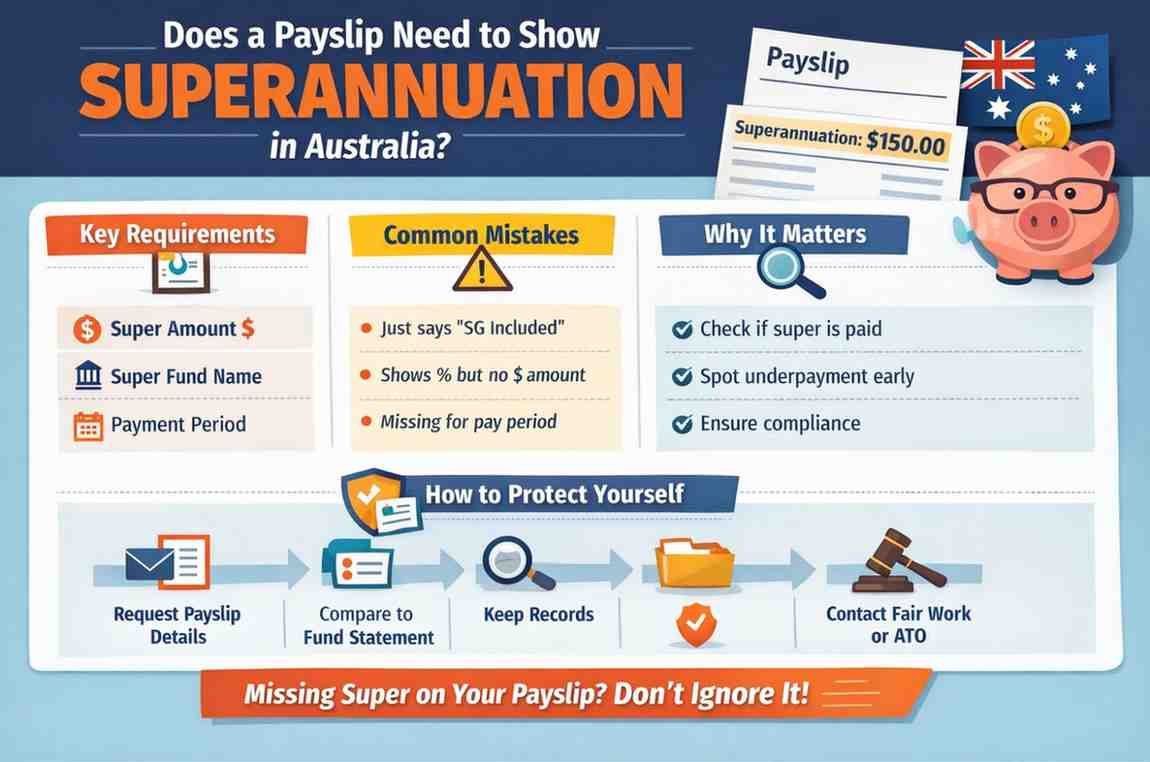
Short answer: Yes, in most cases.
Under Australian law, your payslip must show superannuation details if super is owed for that pay period. That includes the amount of super, the fund name, and often the payment period it relates to. If it is missing, outdated, or vague, that is usually a compliance red flag, not a harmless oversight.
I have spent more than 15 years pulling apart payslips, auditing payroll systems, and helping workers understand why their take-home pay never seems to match what they were promised. Superannuation is one of the most misunderstood line items on an Australian payslip, and conveniently, one of the easiest places for mistakes and quiet non-compliance to hide.
Let’s slow this down and unpack what the law actually requires, what many employers still get wrong, and how to protect yourself if your payslip feels off.
Key takeaways (quick scan)
- Yes, superannuation must appear on a payslip when super is owed.
- The payslip must clearly show the super amount and often the fund name.
- Super can be paid quarterly, but it must still be reported correctly per pay cycle.
- Missing super details can signal underpayment or delayed contributions.
- You have legal tools to challenge incorrect or incomplete payslips.
What does Australian law actually say about super on payslips?
When people ask me this question, they usually expect a simple Fair Work rule. The reality is a mix of payroll law, tax law, and practical enforcement.
Under the Fair Work Act and Fair Work Regulations, employers must provide a payslip within one working day of payment. That payslip must include:
- Gross pay
- Net pay
- Any loadings, penalties, or bonuses
- Superannuation contributions, if applicable
This requirement is enforced by bodies like the Fair Work Ombudsman, while the money itself is policed by the Australian Taxation Office.
Here is the part many people miss.
Even if your employer only pays super quarterly, they still must calculate and disclose the super amount tied to each pay period. In other words, quarterly payment does not excuse invisible reporting.
What exactly must appear on the payslip?
This is where I see the most sloppy payroll practices.
A compliant Australian payslip should show super in a way that is:
- Clear – no abbreviations like “SG” with no explanation
- Quantified – actual dollar amounts, not percentages alone
- Attributable – tied to the correct pay period
Typically, you will see:
- Superannuation contribution amount for that pay
- Super fund name
- Sometimes the contribution rate, such as 11 percent
If your payslip simply says “super accrued” with no figure, that is not good enough in practice, even if some payroll systems technically allow it.
I once audited a mid-sized construction firm where payslips showed super as “included”. Included where? In the vibes? Turned out the employer was underpaying super on overtime for three years.
Does super need to be shown every pay cycle?
Yes, if super is owed for that cycle.
This includes:
- Weekly pay
- Fortnightly pay
- Monthly pay
The only time super may not appear is if no super is legally payable for that period, such as for certain under-18 employees working limited hours.
Otherwise, absence is not normal. It is often a signal that payroll has been configured incorrectly or, worse, deliberately.
Why employers get this wrong so often
Here is some inside baseball.
Most payroll errors around super are not malicious. They come from:
- Legacy payroll software
- Misconfigured award rules
- Outsourced payroll teams following overseas templates
- Employers misunderstanding the difference between reporting and payment
But intention does not matter to the law.
If super is not shown correctly on your payslip, it becomes harder for you to verify whether it was actually paid to your fund. That opacity benefits exactly one party, and it is not the employee.
What others get wrong about super on payslips
This section alone could save you years of lost retirement money.
“If super is paid quarterly, it does not need to show weekly”
Wrong. The obligation to report is separate from the obligation to pay.
“If my contract says total package, payslip details do not matter”
Also wrong. Total package arrangements still require transparent super disclosure.
“If it shows on my super fund statement, the payslip is irrelevant”
Dangerous thinking. Fund statements lag behind. Payslips are your early warning system.
“Only base salary attracts super”
Not always true. Many allowances, bonuses, and overtime payments attract super, depending on how they are classified.
How I personally check a payslip for super compliance
This is the same process I teach junior payroll auditors.
- Check the rate
Is it the correct Superannuation Guarantee rate for the year? - Check the base
Is super calculated on ordinary time earnings, not just base salary? - Check the math
Multiply the base by the rate. Does the number match? - Check consistency
Does this match previous payslips and your contract?
If any one of these fails, I dig deeper.
What to do if your payslip does not show super
Start calm. Go methodical.
- Ask payroll for clarification in writing
- Request a breakdown of super calculations
- Compare payslips to your super fund deposits
- Keep copies of everything
If the response feels evasive or dismissive, escalate. Fair Work and the ATO take super non-compliance seriously, especially repeat offenses.
I have seen employers forced to backpay five figures per employee once audits begin.
Frequently asked questions (FAQ)
Q1: Is it illegal if my payslip does not show super at all?
A: If super is owed for that pay period, yes, it is likely non-compliant and should be corrected.
Q2: Can my employer show super as a percentage only?
A: No. A dollar amount must be identifiable. Percentages alone are not sufficient in practice.
Q3: What if my employer says super is included in my salary?
A: Even in total package arrangements, super must be clearly itemized on the payslip.
Q4: Does super need to appear on casual employee payslips?
A: Yes, if the casual employee is eligible for super for that pay period.
Q5: How long does an employer have to fix a missing super payslip entry?
A: Corrections should be issued as soon as the error is identified, ideally in the next pay cycle.
Final verdict
If your payslip does not clearly show superannuation in Australia, do not ignore it. In my experience, missing or vague super entries are rarely harmless and often the first visible crack in a larger payroll problem.
Your payslip is not just a receipt. It is a legal document, a compliance record, and your frontline defense against underpayment.
Read it like one.
Generate Your Payslip in Seconds
Create an accurate payslip that clearly shows gross pay, tax deductions, superannuation, and net pay. Perfect for employees, freelancers, and employers who want clarity and compliance.
- Instant gross to net breakdown
- Tax and super calculated clearly
- Australia compliant payslip format
No signup required. Fast. Simple. Accurate.